Landscaping profit margin: what good actually looks like

A healthy landscaping business runs 45% to 60% gross margin on maintenance, 30% to 45% on install, and 5% to 15% net.
Many landscapers who feel busy and successful are running net margins under 5%, because two of their largest real costs never appear anywhere in their bookkeeping.
The two invisible costs
Unbilled travel. A two-person crew paid for eight hours that bills six has already lost 25% of its margin, and it is not on any invoice or expense line. It is simply missing.
Equipment depreciation. Mowers, trimmers, trailers, a truck. These do not appear as monthly costs, so they do not appear in the mental maths — until three things need replacing in the same spring and the money is not there.
Both are real costs. Neither shows up unless you deliberately put them in your loaded hourly rate.
Gross versus net
Gross margin is revenue less direct costs — crew wages with burden, plants, materials, machinery hire, disposal. It tells you whether your pricing works.
Net margin is what is left after the yard, the trucks, the insurance, the software, the marketing and a real salary for you. It tells you whether the business works.
If you are not paying yourself a market wage, your net margin is fiction.
Why install margin is lower
A $12,000 patio might carry $4,500 in materials and machinery. The percentage is capped by the material content, exactly as it is in HVAC replacement or roofing.
That is fine. Install generates dollars; maintenance generates percentage. A business with a strong maintenance base and periodic install work has both, and it is much more stable than one doing only installs — where a slow spring is a crisis rather than a quiet month.
Design is your best margin
60% to 80% gross, because it is almost entirely your time and expertise.
It is also the thing most landscapers give away. A free design is a high-margin asset produced at your cost, handed to a customer who is then free to take it to whoever quotes the install cheapest. Charge for it, and credit it against the build.
Route density beats price rises
The most effective margin lever in maintenance is not price. It is the ratio of billable hours to paid hours.
Ten properties within two miles at $50 is a better business than ten at $60 spread across a county. Tightening a route raises margin without risking a single customer relationship — and unlike a price increase, nobody can object to it.
Working out your real numbers
Take a full year. Split revenue into maintenance, install and design. Assign direct costs to each, including crew burden and a realistic equipment allowance. Then total overhead including your own salary.
Most landscapers doing this for the first time find that maintenance is carrying the business and one category of install work is losing money.
Seeing it per job
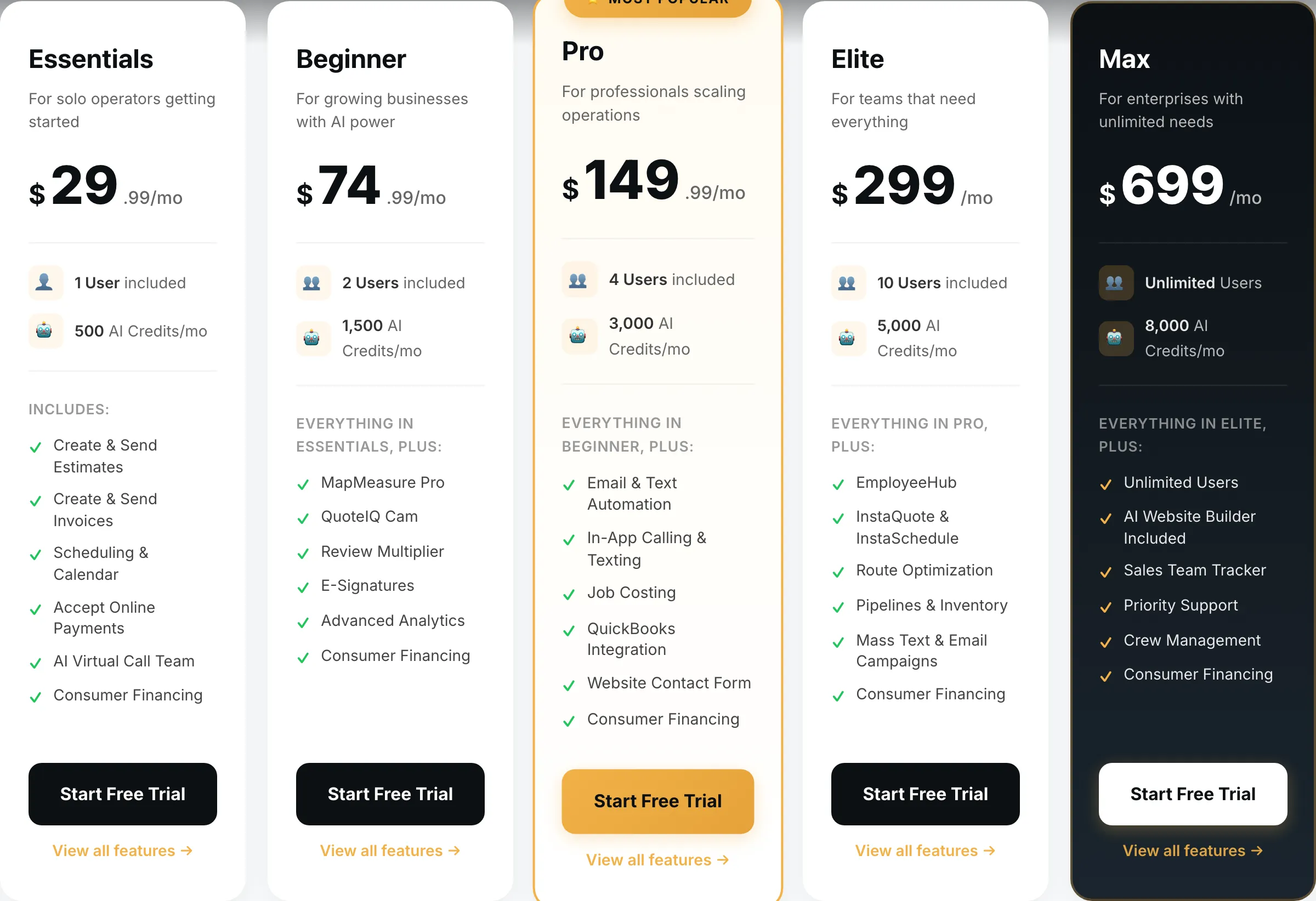
Jobber’s Grow plan at $199/mo adds job costing and automatic time tracking, which together answer the billable-hours question that decides your margin. QuoteIQ includes job costing on Pro at $149.99/mo. Housecall Pro adds employee GPS from Essentials at $189/mo, which is the bluntest way to find out where crew hours actually go.
Questions operators actually ask
What is a good profit margin for a landscaping business?
Gross margin of 45% to 60% on maintenance and 30% to 45% on install work, with net margin of 5% to 15%. Many landscaping businesses run net margins under 5% without realising it, because equipment depreciation and unbilled travel never appear in their numbers.
Why is maintenance margin higher than install margin?
Because install is material-heavy — plants, stone, aggregate, timber — and materials dilute the percentage. Maintenance is almost entirely labour, so it carries a higher gross margin even though the individual jobs are much smaller.
What kills landscaping margin?
Unbilled travel and equipment costs, almost always. A crew paid for eight hours that bills six is a 25% margin loss before anything else goes wrong, and equipment depreciation is invisible until the mower needs replacing.
Should I charge for design?
Yes. Design is 60% to 80% gross margin — nearly pure labour — and it is the single most profitable thing a landscape business sells. Giving it away is producing a high-margin asset for free that a customer can take to a cheaper contractor.
How do I improve margin without raising prices?
Route density and billable-hour ratio. Tightening a maintenance route so crews drive less does more for margin than a price rise, and it does not risk losing customers.