The best pool service software in 2026

The short version
- Best overall for a pool route
- Housecall Pro — Recurring service plans plus real route optimisation. On a dense route that pays for itself.
- Best under five people
- Jobber — Core at $49 with $29 seats, and rescheduling a rained-out day takes seconds.
- Best cheap option
- QuoteIQ — $29.99/mo if your work is mostly repairs, openings and closings rather than a weekly route.
Who this is for
You service pools. Somewhere between twenty and a hundred accounts on a weekly cycle through the season, plus openings, closings, filter swaps, heater repairs and the occasional green-pool recovery that pays for a week.
Pool service is a route business with a chemistry problem. The money is made in stops per day and lost in the accounts that quietly go wrong between visits. Judge software on those two things.
And be clear up front: none of the four general tools here handle chemistry properly. That is the honest headline of this page.
The comparison
| Tool | Starts at | Users included | Best for | Verdict |
|---|---|---|---|---|
| Housecall Pro | $79/mo | 1 | Five or more on a dense route | Route optimisation + recurring plans |
| Jobber | $49/mo | 1 | One to four people | Best all-round, cheap seats |
| QuoteIQ | $29.99/mo | 1 | Solo repair-focused operators | Cheapest; better for repairs than routes |
| ServiceTitan | Quote only | Unlimited | Large operations | Quote-only, enterprise |
Housecall Pro — best for a pool route
$79/mo · Five or more techsJobber’s closest competitor, priced for teams rather than solos, with stronger dispatch and marketing tooling.
Two features make this the pick, and both are things pool service actually runs on.
Recurring service plans. A weekly summer route with a reduced winter schedule, billed monthly in advance, managed as a plan rather than as a schedule you patch by hand every March. This is the best implementation of that idea in the category.
Route optimisation, on the Max plan. Pool routes are dense — twelve to eighteen stops a day within a few miles — and that is precisely the shape where reordering stops properly converts into an extra pool or two per tech per day. At $150+ per account per month, one extra pool a day is not a rounding error.
Essentials at $189/mo includes five seats. Max at $329 includes eight and is where route optimisation lives, which for most real routes is the tier you want.
What it will not do is chemistry. Readings live in job notes, not as data.
What it does well
- Five seats included on Essentials is the best seat-per-dollar deal of the three once you are past two people.
- Dispatch and routing are stronger than Jobber’s at the equivalent tier.
- Recurring service plans on Max are genuinely good if you sell maintenance contracts.
What it does badly
- Worst entry price in the category: $79/mo for a single user, 60% more than Jobber Core for less.
- Extra seats on Essentials are $100/mo — the most expensive seat of any tool here.
- Add-on pricing is not published. You will get those numbers on a sales call, not off the website.
Who it fits: Two to eight people. The seat maths only starts working in your favour once you have a crew.
Jobber — best under five people
$49/mo · One to four person routesThe default field service platform for small home service businesses, and the one most operators compare everything else against.
For a route you can still hold in your head, Jobber is easier to live with and considerably cheaper.
Recurring jobs handle the weekly cycle, monthly recurring invoices handle the billing, and — the underrated one — bulk rescheduling handles the storm days. You will move a day’s route a dozen times a season, and doing it in a few taps rather than pool by pool is worth more than most feature comparisons suggest.
The client hub cuts the “did you come this week” calls, because the customer can see their own visit history.
Core is $49/mo plus $29 per seat, so a three-person operation is $107 against Housecall Pro Essentials at $189. The gap closes at five people and inverts after.
No route optimisation, and no chemistry.
What it does well
- The most polished product in the category. Onboarding is fast and the mobile app is the one crews complain about least.
- Client-facing experience — booking page, quote approvals, payment — is a step above everything cheaper.
- Deepest integration list, so it fits whatever you already run the books in.
What it does badly
- The advertised entry price is one user. Seats are $29/mo each on every tier, so a three-person crew on Core is $107/mo, not $49.
- Automation that most operators consider essential — reminders, follow-ups — is Connect and up, a 2.8x jump from Core.
- Prepaid annual pricing is what the marketing quotes; the no-commitment monthly number is meaningfully higher.
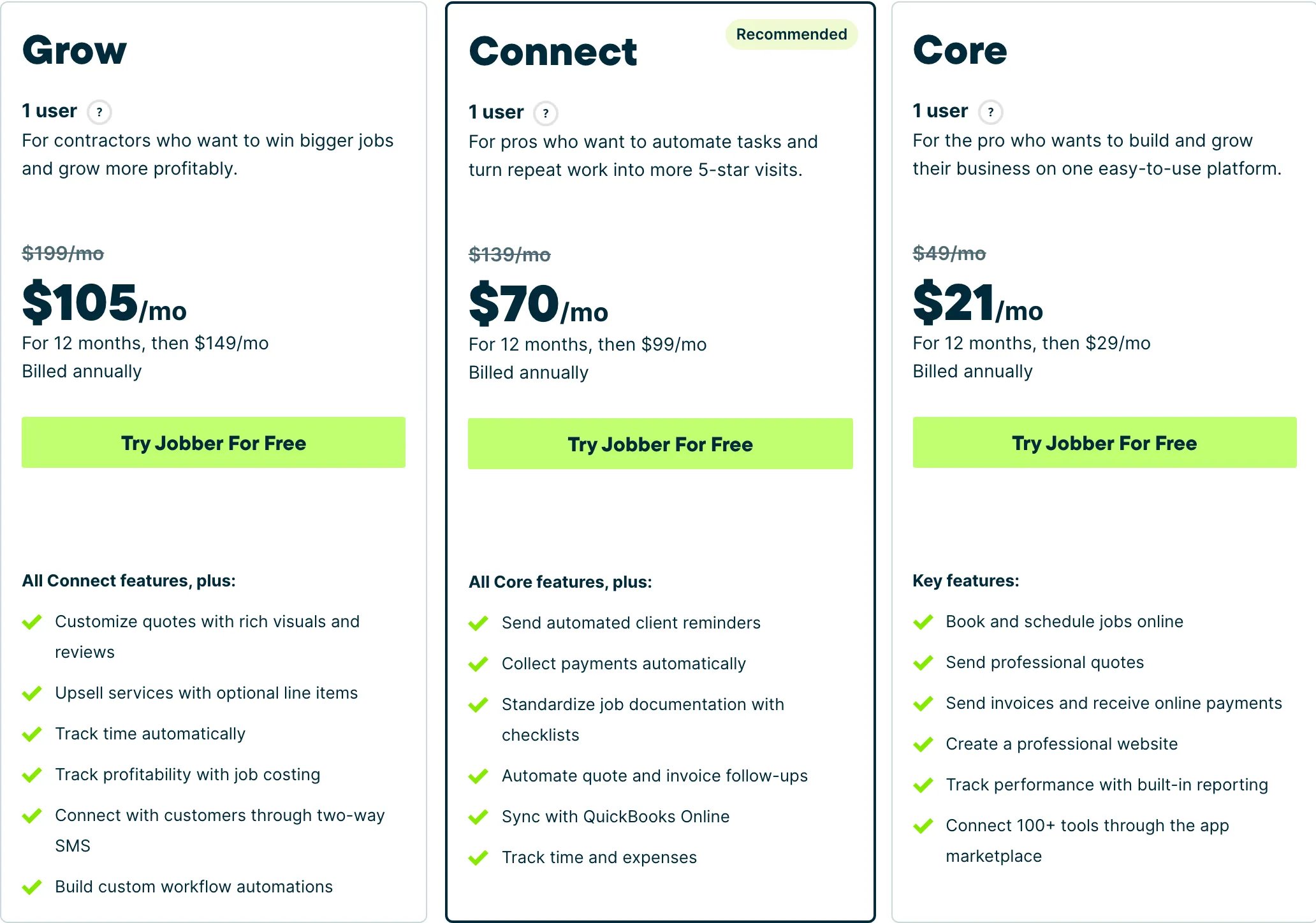
Who it fits: One person to a mid-size crew. The Core tier is genuinely usable solo; the useful automation starts at Connect.
QuoteIQ — cheapest, better for repairs
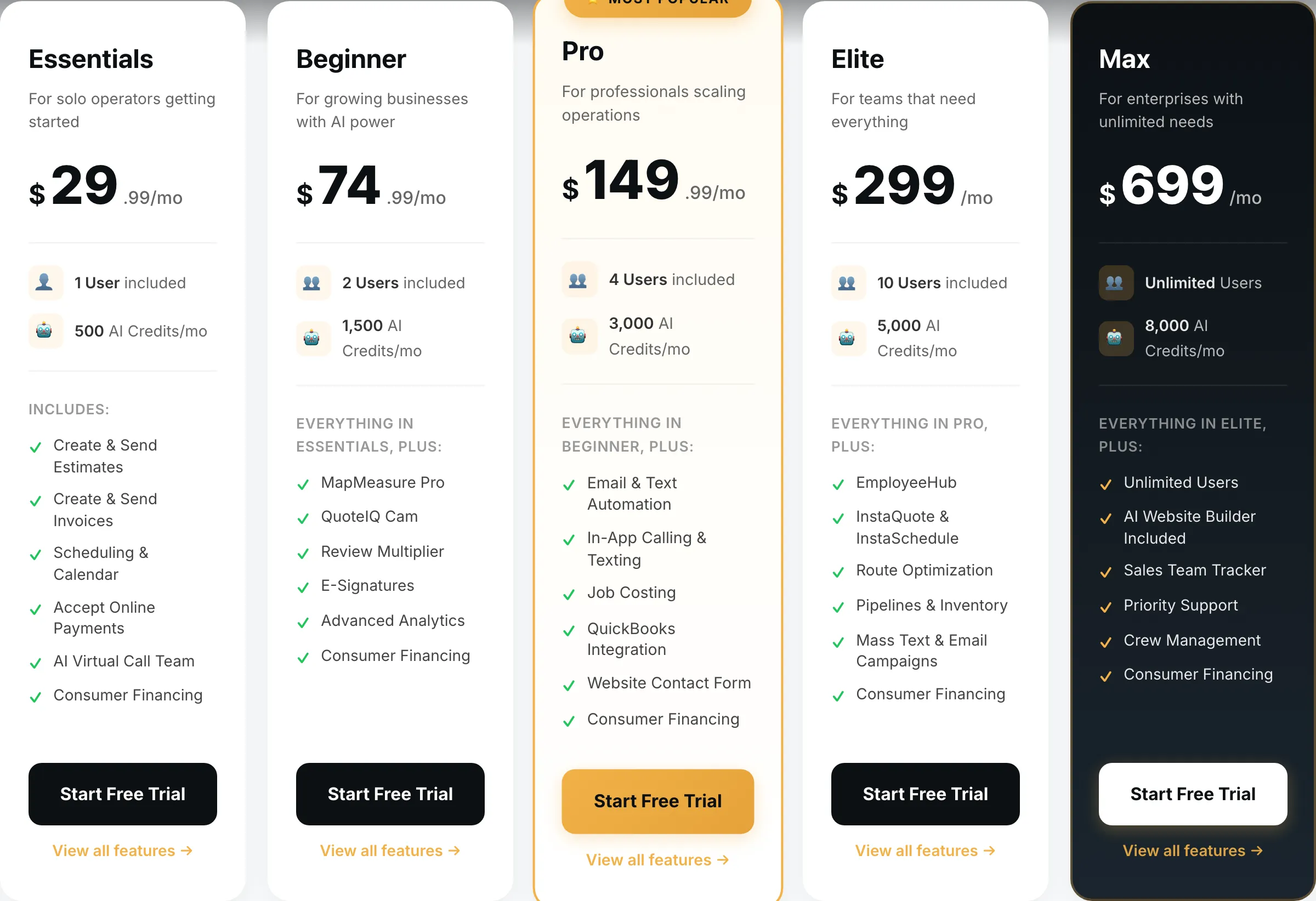
$29.99/mo · Solo repair-focused operatorsField service software built for exterior cleaning and outdoor home service crews, with property measurement baked into the quote.
$29.99/mo, and where it fits pool work is the non-route side: openings, closings, filter and heater jobs, green-pool recoveries. Those are quote-and-invoice jobs, and quoting fast is what this tool is good at.
For a weekly maintenance route specifically it is the weakest of the three realistic options — no route optimisation, and recurring plan management is thinner than Housecall Pro’s.
If your business is 80% repairs and seasonal work with a small route attached, this is fine and it is a third of the price. If it is a 60-account weekly route, spend the extra.
What it does well
- Cheapest real entry point of anything in this category — $29.99 gets a working quote-to-invoice loop, not a crippled trial tier.
- MapMeasure Pro measures a property off satellite imagery, which is the actual job on a lawn, driveway or roof quote.
- Every tier includes the features. No add-on menu bolted on at checkout.
What it does badly
- Smaller company than the incumbents. Fewer integrations, and you will occasionally be the person filing the bug.
- Built around exterior and outdoor trades. If you run commercial mechanical, this is the wrong shape.
- Seat counts are tight below Elite — a four-person crew is already on the $149.99 tier.
Who it fits: Solo operator to a four-person crew, mostly exterior cleaning and outdoor work.
ServiceTitan — the wrong size
Quote only · Large operationsEnterprise field service management for multi-truck operations, sold through a sales process rather than a pricing page.
Named because leaving the market leader out would make this an advertisement.
Quote-only pricing, an annual contract, a paid implementation, and a product built for skilled-trade service calls rather than a high-frequency low-value route. A pool company would be paying enterprise money for dispatch sophistication that a fixed weekly route does not need.
What it does well
- Nothing else touches it for a large operation: reporting, payroll, inventory, call tracking, financing at the door.
- Built for a business where somebody’s full-time job is dispatch.
What it does badly
- No published pricing, an annual contract and an implementation fee. This is not a tool a solo operator buys.
- For a one to four person crew it is the wrong product at any price — you would use perhaps a tenth of it.
Who it fits: Ten trucks and up, with an office manager whose job includes running the software.
The chemistry gap, stated plainly
None of the four tools here store a chemical reading as data. You can write “pH 7.6, FC 2.1” in a job note. You cannot chart it, you cannot get an alert when a pool trends wrong, and you cannot produce a reading history for a commercial client who asks for one.
For a residential route where the tech knows every pool, that is survivable. For commercial accounts, or past roughly sixty pools where nobody can hold them all in their head, it stops being survivable.
The specialists in this space are Skimmer and Pool Brain. We have not verified their current pricing so there are no numbers here — every figure on this site is read off the vendor’s own page and dated, and we will not guess. If chemistry tracking is the thing you actually need, price those two before you buy anything on this page.
How we picked
Prices read off each vendor’s pricing page on 31 August 2026, no-commitment monthly rate, seats added.
For pool service we weighted recurring plan management, route behaviour and how painful a weather day is. We treated chemistry as a hard gap rather than a scoring category, because none of the four have it and pretending otherwise would be the exact failure this page exists to avoid.
We earn nothing from Jobber or ServiceTitan, and Jobber is the recommendation for most small routes anyway.
What we would do
Under 30 accounts, one or two people: Jobber Core at $49.
30 to 60 accounts, a couple of techs: Jobber Connect at $139 for the automated reminders, or Housecall Pro Essentials at $189 if you want the recurring plans done properly.
60+ accounts, dense route, multiple techs: Housecall Pro Max at $329 — and seriously evaluate a pool-specific platform for the chemistry side.
Mostly repairs and seasonal work: QuoteIQ at $29.99.
Questions operators actually ask
What software do pool service companies use?
Most small routes run Jobber or Housecall Pro. Pool-specific platforms like Skimmer and Pool Brain exist and handle chemical readings and dosing properly, which the general tools do not. Under about 60 accounts a general tool is usually enough; past that the specialists start earning their price.
Can these track chemical readings?
Not natively. None of the four record a chlorine or pH reading as structured data you can chart over time. The workaround is a job note or a checklist item per visit, which is fine for compliance but useless for spotting a pool trending wrong over six weeks. That is the single biggest reason pool operators move to a specialist.
Which is best for a weekly route?
Housecall Pro Max, for route optimisation and recurring service plans. On a dense residential route, reordering stops properly is worth an extra pool or two a day, which at $150 a month per account compounds fast.
How should I bill a weekly pool route?
Monthly, in advance, as a recurring invoice against a recurring job. All four support that. Billing per visit creates twelve times the invoicing work and makes your cash flow follow the weather, which is exactly what you do not want going into winter.
What about chemical costs and pricing?
Charge chemicals separately or build a defensible allowance into the monthly rate and review it annually. Chemical prices move more than most operators adjust for, and a flat rate set three years ago is very likely losing money now on every pool.