The best irrigation software in 2026

The short version
- Best overall for irrigation
- Jobber — Annual recurring jobs plus bulk scheduling is precisely the shape of a startup-and-winterisation year.
- Best cheap option
- QuoteIQ — $29.99/mo, and satellite measurement helps price a new install zone by zone.
- Best for a big seasonal push
- Housecall Pro — Route optimisation on Max, which is what 200 winterisations in six weeks actually needs.
Irrigation software, irrigation business software
Same category, two names, and this page covers both. What you are buying is the system that remembers who is due for a startup, routes the winterisation blitz, and invoices the repairs in between.
Who this is for
One to four people installing, servicing and repairing residential and light commercial irrigation. Your year has two mountains — spring startups and autumn winterisations — with repairs, controller swaps and the occasional new install filling the middle.
Irrigation is the most seasonally lumpy trade on this site. Judge software on whether it can schedule two hundred jobs into six weeks and route them sensibly.
The comparison
| Tool | Starts at | Users included | Best for | Verdict |
|---|---|---|---|---|
| Jobber | $49/mo | 1 | One to four people | Annual recurring jobs + bulk scheduling |
| Housecall Pro | $79/mo | 1 | Five or more techs | Route optimisation for the seasonal blitz |
| QuoteIQ | $29.99/mo | 1 | Solo operators | Cheapest; measurement for install quotes |
| ServiceTitan | Quote only | Unlimited | Large operations | Quote-only, enterprise |
Jobber — best for an irrigation business
$49/mo · One to four peopleThe default field service platform for small home service businesses, and the one most operators compare everything else against.
An annually repeating job is a mundane feature that happens to be exactly what this trade needs. Every customer’s winterisation reappears on next year’s schedule without anyone remembering it, and that alone recovers customers most irrigation businesses quietly lose.
Bulk scheduling is the other half. In late September you are placing two hundred jobs into six weeks, and doing that in blocks rather than one at a time is the difference between an afternoon and a fortnight.
Automated reminders on Connect at $139/mo earn their keep here specifically — irrigation visits often need someone home or a gate left open, and a wasted trip in peak season costs you a slot you cannot get back.
Core is $49/mo plus $29 per seat. No route optimisation.
What it does well
- The most polished product in the category. Onboarding is fast and the mobile app is the one crews complain about least.
- Client-facing experience — booking page, quote approvals, payment — is a step above everything cheaper.
- Deepest integration list, so it fits whatever you already run the books in.
What it does badly
- The advertised entry price is one user. Seats are $29/mo each on every tier, so a three-person crew on Core is $107/mo, not $49.
- Automation that most operators consider essential — reminders, follow-ups — is Connect and up, a 2.8x jump from Core.
- Prepaid annual pricing is what the marketing quotes; the no-commitment monthly number is meaningfully higher.
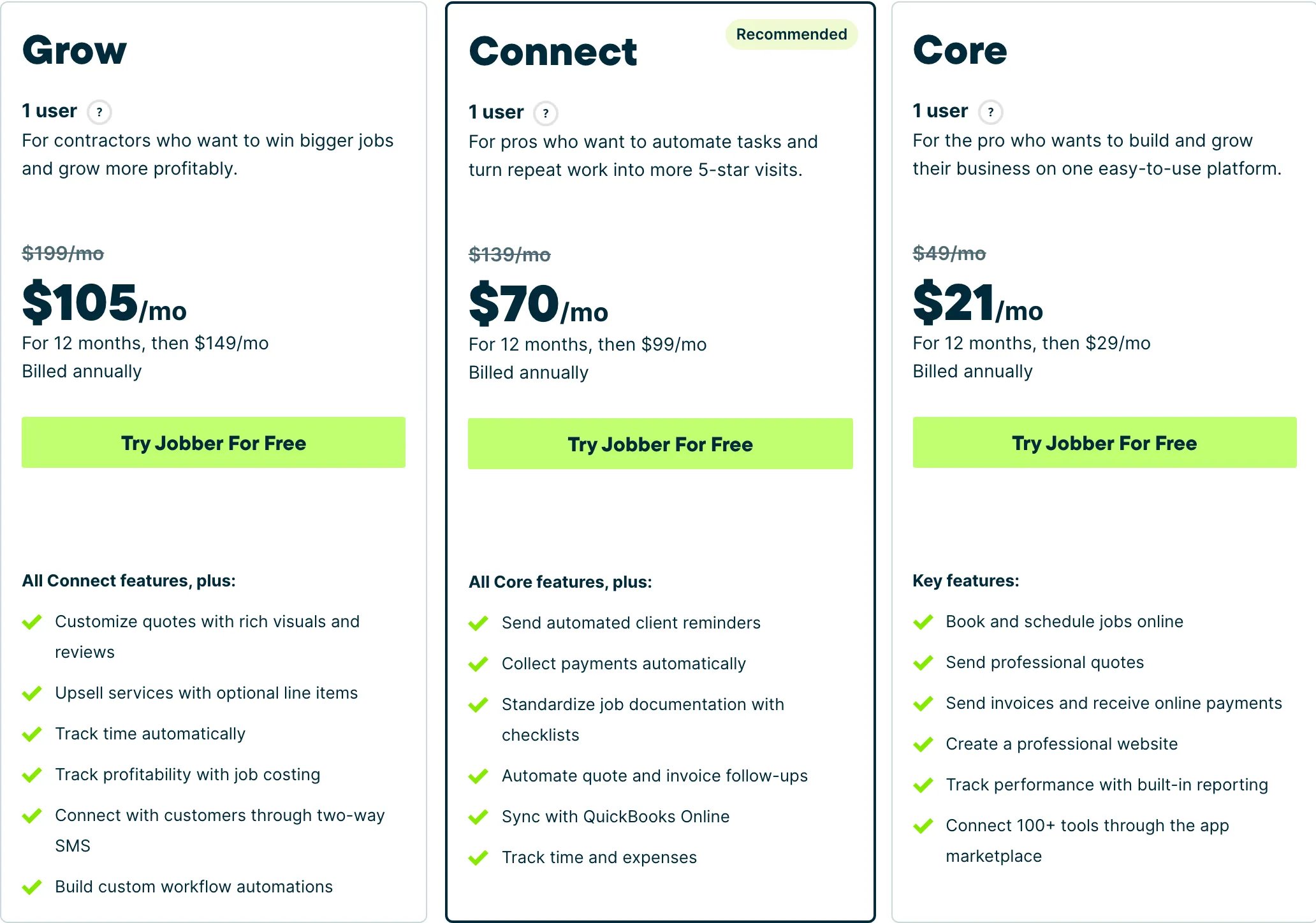
Who it fits: One person to a mid-size crew. The Core tier is genuinely usable solo; the useful automation starts at Connect.
Housecall Pro — best for the seasonal blitz
$79/mo · Five or more techsJobber’s closest competitor, priced for teams rather than solos, with stronger dispatch and marketing tooling.
If you are running several techs through a compressed winterisation season, route optimisation on the Max plan is worth more here than in almost any other trade. Winterisations are short visits clustered in neighbourhoods — the densest routing problem there is, and the one where reordering stops properly adds several jobs a day.
Recurring service plans handle a sold annual package — startup, mid-season check, winterisation — as a managed plan rather than three schedules you patch by hand.
Essentials at $189/mo for five seats, Max at $329 for eight with the routing. Ignore Basic at $79 for a single user.
What it does well
- Five seats included on Essentials is the best seat-per-dollar deal of the three once you are past two people.
- Dispatch and routing are stronger than Jobber’s at the equivalent tier.
- Recurring service plans on Max are genuinely good if you sell maintenance contracts.
What it does badly
- Worst entry price in the category: $79/mo for a single user, 60% more than Jobber Core for less.
- Extra seats on Essentials are $100/mo — the most expensive seat of any tool here.
- Add-on pricing is not published. You will get those numbers on a sales call, not off the website.
Who it fits: Two to eight people. The seat maths only starts working in your favour once you have a crew.
QuoteIQ — best cheap option
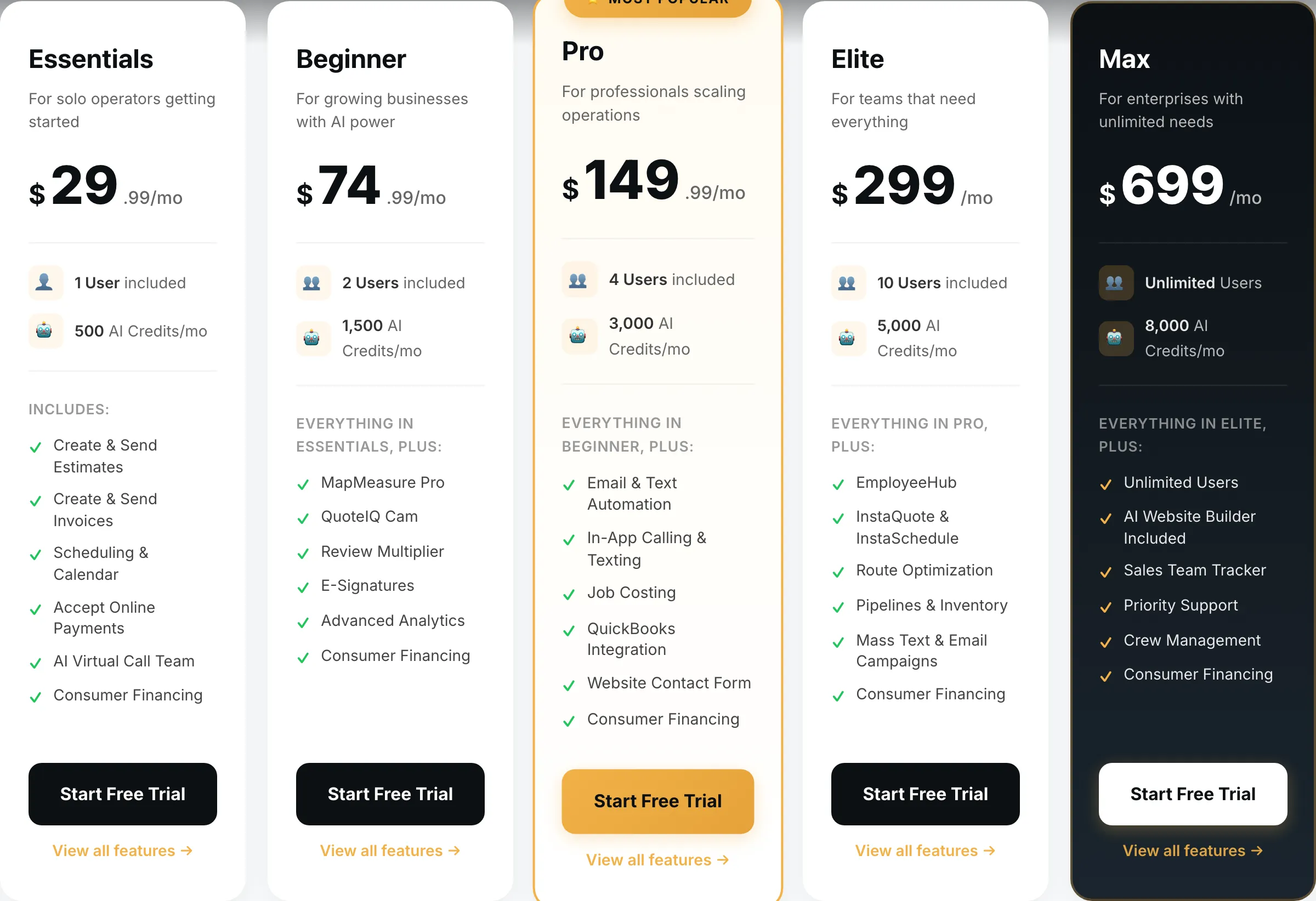
$29.99/mo · Solo operatorsField service software built for exterior cleaning and outdoor home service crews, with property measurement baked into the quote.
$29.99/mo, and MapMeasure Pro genuinely helps on the install side — measuring a property to plan zones and estimate head counts before you quote. For an operator whose revenue skews to installs and repairs rather than a large service book, this is the sensible spend.
For a pure service route of several hundred seasonal customers it is the weakest of the three realistic options: no route optimisation, and thinner recurring management. Check during the trial that an annual repeat interval is straightforward before you commit.
What it does well
- Cheapest real entry point of anything in this category — $29.99 gets a working quote-to-invoice loop, not a crippled trial tier.
- MapMeasure Pro measures a property off satellite imagery, which is the actual job on a lawn, driveway or roof quote.
- Every tier includes the features. No add-on menu bolted on at checkout.
What it does badly
- Smaller company than the incumbents. Fewer integrations, and you will occasionally be the person filing the bug.
- Built around exterior and outdoor trades. If you run commercial mechanical, this is the wrong shape.
- Seat counts are tight below Elite — a four-person crew is already on the $149.99 tier.
Who it fits: Solo operator to a four-person crew, mostly exterior cleaning and outdoor work.
ServiceTitan — the wrong size
Quote only · Large operationsEnterprise field service management for multi-truck operations, sold through a sales process rather than a pricing page.
On the page because omitting the market leader would make it an advertisement.
Quote-only pricing, an annual contract, a paid implementation, built around a full-time dispatcher and year-round call volume. A seasonal irrigation business with two mountains and a quiet winter is the wrong shape for that commitment.
What it does well
- Nothing else touches it for a large operation: reporting, payroll, inventory, call tracking, financing at the door.
- Built for a business where somebody’s full-time job is dispatch.
What it does badly
- No published pricing, an annual contract and an implementation fee. This is not a tool a solo operator buys.
- For a one to four person crew it is the wrong product at any price — you would use perhaps a tenth of it.
Who it fits: Ten trucks and up, with an office manager whose job includes running the software.
How we picked
Prices read off each vendor’s own pricing page on 31 August 2026, no-commitment monthly rate with seats added.
For irrigation we weighted annual recurring scheduling, bulk scheduling into a compressed season, and routing density. We treated backflow certification tracking as a known gap across all four rather than a scoring category.
We earn nothing from Jobber or ServiceTitan, and Jobber is the pick.
What we would do
Under 100 customers, solo: QuoteIQ at $29.99, or Jobber Core at $49 if the service book is growing.
100 to 400 customers, one to four people: Jobber Core with seats, Connect at $139 for the reminders once wasted trips start hurting.
Several techs, big seasonal blitz: Housecall Pro Max at $329 for the routing.
Test the trial in September, not in July. Any tool handles a quiet month.
Questions operators actually ask
What software do irrigation companies use?
Most run a general field service tool — Jobber or Housecall Pro — because the work is fundamentally recurring visits plus repairs. The distinguishing need is handling two big seasonal pushes rather than an even year, and both handle that with recurring jobs and bulk scheduling.
How do I schedule 200 winterisations in six weeks?
Set them as recurring jobs that repeat annually, then bulk-schedule the whole block and route it geographically. This is the single highest-value thing software does for an irrigation business — the alternative is a spreadsheet and a lot of phone calls, and every customer you forget is one who calls somebody else next spring.
Can these track backflow test certifications?
Only as attachments and job notes. None of them manage certification expiry as structured data or submit to a water authority. If you do volume backflow testing you will keep a separate register regardless of which tool you buy.
Should I bill seasonal service as a package?
Usually yes. A startup, a mid-season check and a winterisation sold as one annual package smooths your cash flow and locks the customer in for the autumn — which is the visit people otherwise skip. All four support recurring invoicing against a plan.
Is it worth it for a one-person irrigation business?
Once you are past roughly a hundred customers on an annual cycle, yes. Below that a calendar works. The economics change the moment you cannot remember who is due, because a forgotten winterisation is a burst manifold and an angry customer in April.