How to price lawn care

Lawn care prices at $35 to $55 a visit for a small lot, $45 to $75 for a medium one, and $65 to $120 for large properties. Most weekly customers pay $140 to $300 a month.
The formula that actually matters
Lawn care is not priced by area. It is priced by time on site plus time getting there, and the second one is what most operators leave out.
(Turf area × rate) + obstacle time, floored at your minimum — then sanity-checked against drive time.
A 7,000 sq ft turf area, open lot, one gate, ten minutes from your previous stop:
- 7,000 × $0.008 = $56
- Standard obstacles, no adjustment
- Above the $40 minimum → $55 per visit
That is roughly 35 minutes on site. With 10 minutes of drive, 45 minutes of your day for $55, or about $73/hr against your machine and fuel. That works.
Now the same lawn 25 minutes away: 60 minutes of your day for the same $55, which is $55/hr. Same price, materially worse job.
Price a lawn care job
Your numbers, the formula above. Nothing is sent anywhere — this runs in your browser.
$56 base (7,000 square feet of turf × $0)
This is a starting number, not a bid. Walk the property before you send it.
Route density beats rate
This is the thing that separates lawn care businesses that make money from ones that are merely busy.
Ten properties within two miles of each other, at $50 each, is a better business than ten properties at $65 spread across a county. The first fills a day with billable minutes; the second fills it with driving.
Which means: when you are quoting a property on a street where you already have three customers, you can afford to be competitive. When you are quoting one twenty minutes outside your route, you should be expensive or decline it.
Most operators price the property. The ones who do well price the stop.
What changes the price
Turf area, not lot size. Measure what you mow.
Obstacles. Trees, beds, play equipment, trampolines — every one is a slow turn.
Gates and access. Narrow gates mean the small mower, which doubles the time.
Slope. Anything you cannot ride is hand work.
Frequency. Weekly cheapest per visit, monthly dearest.
Dog waste. Say it plainly in the quote: yards not cleared may be skipped or charged. Every operator knows why this line exists.
The mistakes
Quoting from lot size. You do not mow the driveway.
Ignoring drive time. The single most common profitability error in this trade.
No minimum. A tiny lawn is still a stop, a setup and a pack-down.
Never raising prices. Costs rise annually; routes that do not get repriced quietly become unprofitable.
Giving away the extras. Aeration, overseeding, fertiliser and clean-ups are where the margin is. Quote them separately, every season.
Building and billing a route
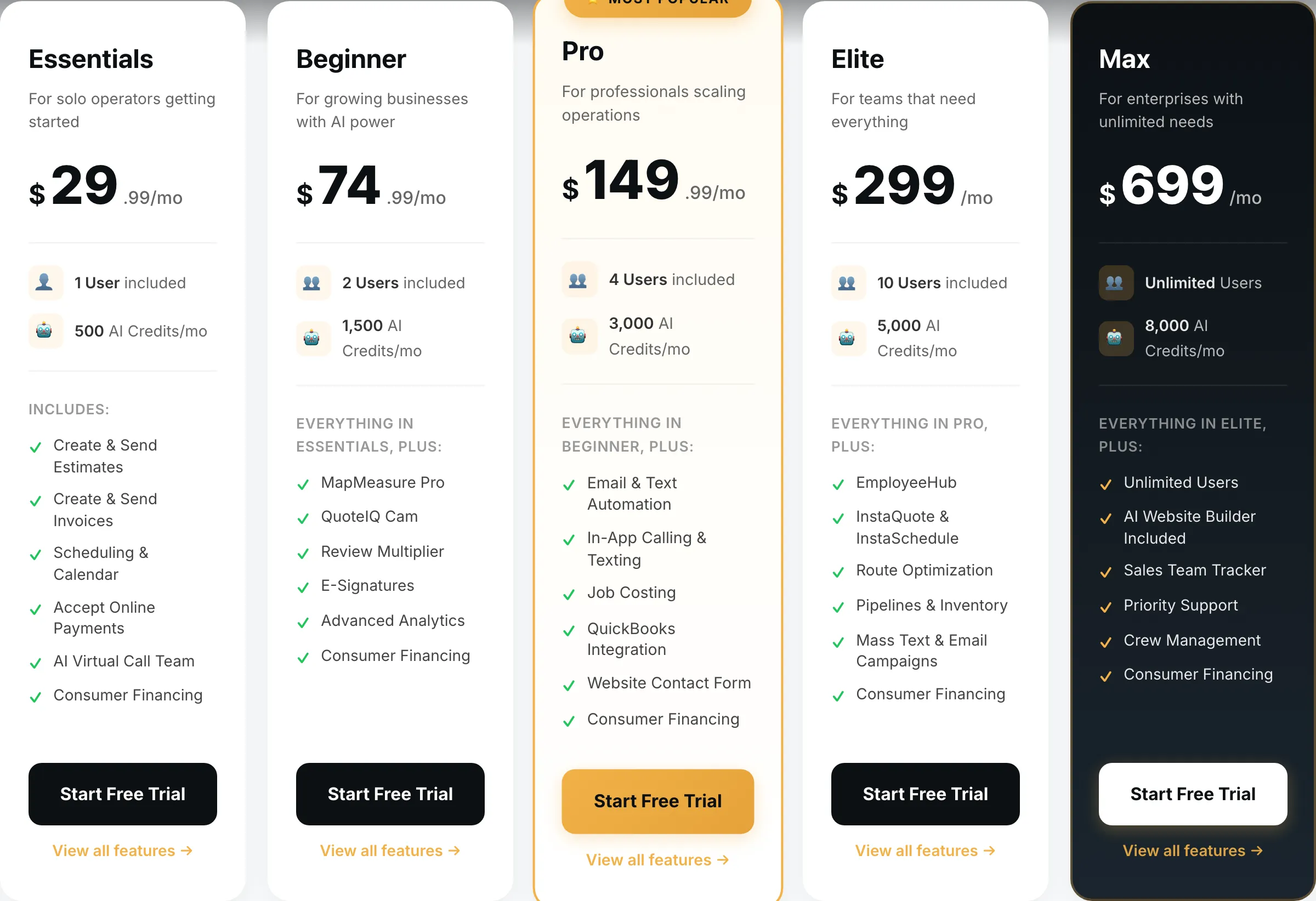
Jobber at $49/mo runs recurring jobs with monthly recurring invoicing, which is the entire administrative requirement of a lawn round. QuoteIQ at $29.99/mo measures the turf area off satellite imagery, which is exactly the input this formula needs. Housecall Pro Max adds route optimisation — directly relevant given everything above about density.
Questions operators actually ask
How much should I charge for lawn care?
$35 to $55 a visit for a small lot, $45 to $75 for a medium one and $65 to $120 for large properties. Most weekly customers pay $140 to $300 a month. Set a job minimum around $40 — below that the drive costs more than the cut earns.
How do I price by lawn size?
Measure the turf area, not the lot. Driveways, beds, buildings and paving are not mowed. Roughly $0.006 to $0.012 per square foot of actual turf, then apply your minimum and adjust for obstacles and gates.
Why does route density matter more than price?
Because drive time is unbillable. Ten properties within two miles is a completely different business from ten spread across a county, at exactly the same per-visit price. A slightly lower price on a dense street beats a higher one across town.
Should weekly cost less per visit than monthly?
Yes. A monthly cut is far more work — longer grass, more clippings, more strain on the machine. Weekly should be cheapest per visit and monthly dearest, and showing the ladder moves customers onto weekly, which is better for both of you.
How do I raise prices on a lawn route?
Annually, in writing, before the season starts, with a specific dollar figure. Fuel, insurance, equipment and labour all rise every year. A route that has not had a price increase in three years is a route that is quietly losing money.